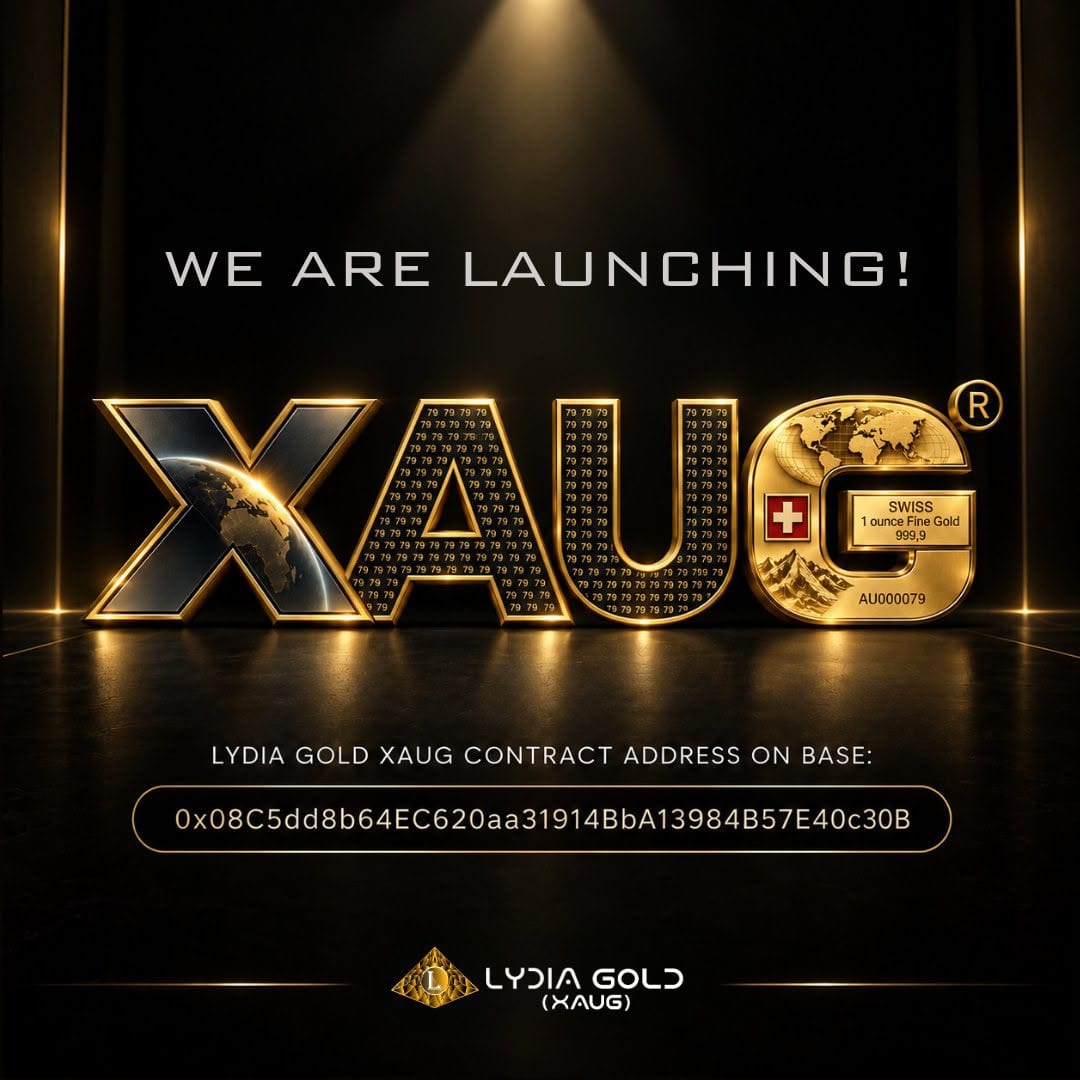
Lydia Gold (XAUG)
One XAUG is one gram of allocated fine gold.
Lydia Gold is a digitally transferable representation of eligible, allocated physical gold held under high-security Swiss custody standards. It is designed without leverage, fractional-reserve issuance, algorithmic inflation or yield promises.
- 1.000000 g
- of eligible, allocated fine gold represented by each XAUG
- Swiss custody
- allocated, serialised and segregated under high-security standards
- 4 of 7
- key holders must sign before any mint can execute
- From 1 g
- redemption design, with physical delivery targeted from 100 g
Physical gold comes first. Supply follows.
Tokens do not create backing. Backing authorizes tokens. The contract that governs XAUG enforces a single rule, and no governance vote or emergency function can override it.
The supply rule
totalSupply ≤ confirmedEligible
Circulating XAUG can never exceed the grams of eligible fine gold that custody has confirmed. The constraint is immutable.
On-chain supply right now: 3,215.07 XAUG, read live from the contract on Base.
A mint happens only after
- Final custodian confirmation of eligible fine gold
- Independent reserve attestation
- Institutional controller authorization
- Multi-signature validation
A burn follows every
- Redemption
- Physical withdrawal
- Inter-vault transfer
Supply grows only when physical gold enters custody and shrinks only when it leaves.
Built on three things
Allocated physical ownership
Eligible, allocated and serialised fine gold, measured on fine-gold content rather than gross bar weight, and held under high-security Swiss custody standards.
Mathematical supply integrity
On-chain supply is strictly limited to independently confirmed eligible fine-gold reserves. The limit is written into the contract and cannot be overridden by governance.
Dual-layer institutional architecture
A public layer for transferability and a permissioned settlement layer for custody, reconciliation, audit and redemption, kept separate by design.
From vault to chain, in order
No token is minted without verified vault confirmation. Each step has to complete before the next one can start.
- 1
Gold deposit
Gold enters the approved Swiss custody environment. It is not yet mint-eligible.
- 2
Assay, fineness and title verification
Bar or lot identity, gross weight, assay fineness and clear title are checked.
- 3
Final custody allocation
The eligible fine-gold content is calculated and allocated in the vault registry.
- 4
Custodian attestation
The custodian produces a signed final-allocation attestation.
- 5
Independent validation
An independent reserve validator confirms the eligible fine-gold amount.
- 6
Multi-signature authorization
A quorum of independent key holders authorizes the mint. No one can do it alone.
- 7
On-chain mint
The mint may not exceed the newly confirmed grams. The event records its timestamp, vault reference and attestation hash.
Two layers that do different jobs
Public liquidity layer
An ERC-20 compatible token that can be transferred globally. Transfers at protocol level are intended to remain permissionless where legally permitted.
Institutional settlement layer
Permissioned infrastructure that holds all mint and burn authority and connects the custodian API, reserve reconciliation, audit verification and redemption processing.
Public liquidity does not override vault-backed discipline. A licensed market-price feed informs valuation and dashboards, but it has no path into minting: price does not determine supply.
Custody and governance
Allocated means each gram backing XAUG is traceable to allocated bars or lots inside the custody system and is never counted as part of an unallocated pool.
The gold behind XAUG is
- Fully allocated
- Serialised and uniquely identifiable at bar or lot level
- Segregated from unallocated pools and operational assets
- Unencumbered and non-rehypothecated
- Structured for legal segregation, subject to binding custody documentation and legal opinion
Three separate entities
No operating entity may pledge, lend, rehypothecate or otherwise encumber the gold backing circulating XAUG. The structure is intended to keep reserve gold segregated and bankruptcy-remote.
- Mining SPVAsset production entity
- Custody SPVVault interface entity
- Token Issuer SPVDigital representation entity
Seven keys, four to mint
Mint authority cannot be exercised by one party. An emergency pause needs five of the seven keys, and it can only freeze minting or redemption temporarily. A pause cannot mint.
- Custody authority
- Compliance authority
- Technical authority
- Governance authority
- Independent external validator
- Risk officer
- Reserve backup key
How the reserve is checked
- Periodic independent assurance or audit
- Daily issuer and custodian reconciliation
- Custodian-signed reserve events and attestations
- On-chain liability and supply verification
- Publication of a cryptographic attestation hash
Redeeming for gold
Subject to the applicable terms, custody structure and compliance requirements, XAUG is designed to support redemption from one gram, by internal vault reallocation, inter-vault transfer or physical delivery.
Holding at protocol level
You may hold and transfer XAUG where legally permitted. Holding the token does not by itself transfer legal title, re-register a vault position or create a right to physical delivery. Those are governed by the custody agreement and compliance requirements.
Redeeming as a verified participant
Compliance-verified redeemers may request redemption from 1 gram. Physical delivery is targeted from 100 grams, subject to bar format, fees and logistics, after KYC and AML, sanctions and source-of-funds checks.
The order never changes
- 1Redemption request
- 2Token lock or escrow
- 3Compliance and custody approval
- 4Irrevocable release instruction
- 5Burn
- 6Asset release and settlement
No reserve gold may leave eligible custody without a matching, auditable reduction in circulating XAUG. The burn happens no later than the moment the release becomes irrevocable.
Target timelines
- T+1
- Internal custody reallocation and settlement, after approval.
- T+3
- Inter-vault transfer or physical release instruction, after approval. Actual delivery varies by vault, logistics, customs and destination.
What you can verify
The transparency framework has two levels: figures anyone can read, and bar-level detail for verified institutions.
Open to everyone
- Total vault grams
- On-chain total supply
- Reconciliation delta, expected to be zero
- Timestamp of the last confirmation
- Attestation hash reference
For verified institutional participants
- Serial number allocation reports
- Bar breakdown
- Vault certificate documentation
- Detailed audit material
- Custody-level reporting APIs
How it differs from other ways to hold gold
| Vehicle | Structural limit |
|---|---|
| Gold ETF | Custodian dependency and settlement delay |
| Physical bullion | Illiquid and slow to move |
| Unallocated gold | Counterparty exposure |
| Typical gold tokens | Centralized minting and trust that rests on audits alone |
| XAUG | Allocated, reserve-constrained, verifiable and neutral |
What XAUG is designed without
The objective is durability, not speculation. XAUG is meant to behave like digital allocated bullion.
- Yield promises
- Leverage
- Fractional-reserve issuance
- Algorithmic or governance-driven inflation
- Emission schedules or staking rewards
- Liquidity mining
Risks you should understand
Market risk
The gold price moves, and the secondary-market price of XAUG moves with it. XAUG represents allocated physical gold exposure and does not reduce gold-price risk. No fixed price, spread or peg is guaranteed.
Custody risk
Concentrating custody in one jurisdiction carries geopolitical and regulatory exposure. It is addressed through Swiss institutional custody, contractual segregation and insurance, independent assurance and contingency planning.
Operational risk
Technical disruption, oracle malfunction or governance compromise are possible. Multi-signature controls, an emergency pause that cannot mint, and redundant verification layers are the safeguards.
Regulatory risk
Commodity-backed digital instruments are subject to evolving regulatory interpretation. Classification is determined separately in each jurisdiction by qualified counsel and, where applicable, the competent authority.
Conditions for issuance and distribution
Mining resources and in-ground reserves do not back circulating XAUG. Only physical fine gold that has completed refining or assay, final custody acceptance and allocation can authorize minting. Public issuance and institutional distribution depend on the following.
- Clear title to all reserve gold and approved chain-of-custody documentation
- Final Swiss custody agreement, segregation terms and insurance confirmation
- Defined acceptance, refining, assay and fineness procedures
- Jurisdiction-specific legal opinions on classification, holder rights, insolvency treatment and redemption
- An independent assurance and reserve-attestation mandate
- A smart-contract security audit and production key-management controls
- Benchmark and market-data licences where required
- Operational AML, sanctions and institutional onboarding policies
- Approved, binding issuance, custody and redemption terms
Distribution, in stages
- Phase 1Private distribution only.
- Phase 2Selective listing on regulated exchanges.
- Phase 3Institutional trading venues.
Lydia Gold is built for private banks, family offices, institutional allocators and long-term wealth preservation.
The contract on Base
Check the address before you transact. This is the only XAUG contract published by Lydia.
Not a token product. Digital gold infrastructure, built to last.
This page describes the design of Lydia Gold (XAUG) as set out in its institutional and protocol paper. It is not an offer, a solicitation or investment advice. The legal and regulatory classification of XAUG is determined separately in each jurisdiction. XAUG does not reduce gold-price risk, and no fixed price, spread or peg is guaranteed. Issuance, redemption, custody-level title registration and physical delivery are subject to the applicable terms and to KYC, AML, sanctions and source-of-funds checks.